Northern Journal Article on NWT event at National Arts Centrein Ottawa April 30, 2013


Northern Journal Article on NWT event at National Arts Centrein Ottawa April 30, 2013
Jim Green’s latest cd – Stories from the Ice Coast was reviewed by the Northern Journal in Fort Smith on June 25th, 2013.

Review by Megan Wohlberg, Northern Journal June 25/13
Published in EDGE YK Issue 7: April/May 2013

Click on the picture to read the entire story in Edge Magazine
by JACK DANYLCHUK
Northern Journal
Tue, Jun 19, 2012
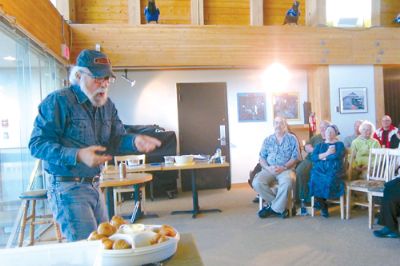
Spilling anecdotes and spouting tall tales, with plenty of body language for emphasis, a busload of Northern storytellers took to the road last week with the Northern Arts and Cultural Centre’s annual festival.
The theme this year is “Transitions,” Ben Nind, NACC director, told the opening night audience Friday at the Prince of Wales Northern Heritage Centre. “We challenge the tellers and the listeners to reveal themselves in the light, life and laughter of the stories.”
Opening the week-long festival in Yellowknife, Dawn Lacey riffed on buns; her own, “still firm at 60,” she joked, and the “overnight buns” she loves to bake: whole wheat and white, sweetened with honey, and her favourite, cinnamon, sticky with icing.
Buns were the perfect metaphor, creating an audience of hungry listeners by the time Paul Seesequasis took the stage.
Seesequasis, until recently a desk-bound arts bureaucrat, remarked on his own transition from writer to storyteller, and the difference between words on and off the page.
“I’m not really a storyteller,” he confessed, and read excerpts from his book, The Tobacco Wars, a faux history of Pocahontas, that takes Powhatan’s daughter from the forests of the New World to the fetid streets of 17th century London.
Anthony Foliot, introduced as “bard of the barge on the bay,” told stories drawn from his adventures with Skipper Dave as a deckhand with the East Arm Freighting Company. His delivery channeled the rhyming style of Robert Service and the good natured bombast of the Snow-King, the central character in Foliot’s annual winter performance piece on Yellowknife Bay.
Fort Smith raconteur Jim Green related an almost believable tale of a misplaced body, a bootlegger, a Yellowknife tow truck driver (who was an undertaker when opportunity dictated) and baffled police.
The story was lifted from a collection of stories that started as a novel but never made it to print. The book cover, a tapestry of Gold Range characters drawn by Walt Humphries, now decorates a CD that Green merrily sold at the end of his performance.
Michael Kusugak, Moira Cameron, Pat Braden, Judy Sharp, Scott McQueen and John B Zoe appeared Saturday afternoon and evening at the Heritage Centre café before the festival took to the road.
The tour passed through Behchoko on Monday, stopped in Fort Providence on Tuesday and then headed for Kakisa. The show closes in Fort Smith this Saturday after appearances in Hay River on Thursday and Enterprise on Friday.
“This is an exciting event both for the communities and the tellers from here at home and beyond,” said Nind. “Each concert is different and each story significant.”
NORTH PAWS
Here’s another northern site I’m fond of and contributing to. North Paws is looking to tell the stories of Northern people and their experiences with Northern dogs. Above all else, it’s a site concerned with the welfare of dogs in the north. With an amazingly talented production team, this project will deliver some top notch products.
We`re looking for stories of the ancient world, stories of our living elders histories, and stories in modern times.
We want to bring to light the challenges, successes and positive efforts of people in the North who are living with dogs.
Here are some possible topics:
|
Yellowknife Documentary Project: “Ultra-cool”
I like this project because it welcomes ordinary folks to tell their Yellowknife stories. If you live in Yellowknife, used to live there, visited once and loved it or are purely a Yellowknife fan, you can get involved. The project team encourages people to collaborate to create a documentary about , what they call, “this ultra-cool city”.
They ask you to think about what you love about Yellowknife. What makes it unique? What makes it tick? What’s your best memory of the place? How has it affected your life? Then go ahead and put those thoughts on film. Make a video.
No experience is necessary. You can do it using the camera on your phone or a video camera. It doesn’t matter. “All videos and video-attempts are welcome.” Then you can share your video with others, with the whole doggone world, by uploading it to the YK Doc Project website. You and other fans can then comment on all the different video clips.
The project team says their goal “is to figure out which video clips resonate with fans.” And then, as more and more clips get added, different themes will emerge. It’s true, they will. And those themes “will inform the basis for a longer form documentary about Yellowknife”.
I like it. The fans become the filmmakers, collaborating to tell the Yellowknife story through the lens of their personal experiences, with their own voices, on camera. Living history by real people. Yeah!
Check out the site. So far, December 2011, my favorite video is the one about ravens.
First I wanna tell you the all time number one
supreme ruler and winner of the red ribbon
for record breaking best music in my house
and that’s the ‘ping’ ‘ting’ ‘tick’ ‘tock’ ‘pock’
sounds of homemade jelly cooling in the jars
the jars cooling off shrinking the air inside
so’s the sealer lids get snapped down tight
Course by that time the kitchen is like to burst
so swole up with all those smells swapping around
it’s enough to confuse the most experienced of noses
like it was this weekend in my cabin in the woods
after I’d boiled and bottled high bush cranberry jelly
followed up with radiant red raspberry jelly and then
chokecherry jelly so strong it was pertnear black
And since I’m doing this in the month of March
I’m getting to replay all the fine outside hours
I put in last August and September and October
under a cacophony of raucous ducks and geese
sharing the berry patches with fat-sleek bears
My dog got such a snoot-full of warm bear all he
wanted was to race me to the truck, git gone
I’m thinking too about my grandson and granddaughter
getting to the age where they could be picking berries
how much I’d love to take them out in the bush with me
sharing the secrets of the berry people with them
where to find them, when to wait, how best to pick them
and how to lick your berry mustache with your berry tongue
after you bite into your berry jelly smeared berry bread
I’ll tell you what, you twist some arms on global warming
so my grandkids have some kinda future to look forward to
them and the rest of world’s mushrooming mob of grandkids
who are all going to need clean air, water, and food to eat
You do whatever you can do, kick a little butt if need be
I’ll take your kids out berry picking and we’ll make jelly
at your house and listen to the music as the jars cool down
I declare that this poem is my own work entirely and that I hold all publishing rights to it. I give Powell River Live Poets’ Guild the right to send my poem to President Obama on the occasion of his inauguration on January 20, 2009 and to publish this poem as part of “Poems for Obama from Canada” collection (or similar title) without any compensation beyond crediting me with authorship. Jim Green
November 20, 2010
Nancy Schildt
First Unitarian Church of Honolulu
Dear Nancy;
One Sunday in October I somehow found myself not only inHawaiibut in the First Unitarian Church of Honolulu where a hot band was warming up of all things. Strange doings. Then, gradually, an almost empty building became filled with the warmth of humanity as a wonderful community came together. Then a vocal section got tuned up as well for goodness sakes. More and more warm folks filled the room. I didn’t feel like a stranger at all. I felt welcome. It felt like a fine place to be. I wondered if people were wondering about the goofy grin spread across my face. I felt so good I thought I might cry. Cry for happy.
All the visiting storytellers on Sunday felt that way. I know they did. You could feel it in their/our voices. We shared our stories with the pure joy of sharing. The way it should be. The way it was truly meant to be.
Afterwards, a young lady recently from Oregon came up to thank me. She said she had been debating whether or not to attend the Church for the first time that Sunday. She decided to come. And she was so glad she’d made that decision, she said . She was so happy to have shared that special occasion with everyone gathered there. She was overwhelmed, she said, at what had happened.
I told her that it was no great mystery. I told her it was pretty simple in fact.
“This,” I told her, “is exactly where you were meant to be today.”
And I realized while those words were rolling outta my mouth that the same was true for me. Right there in the First Unitarian Church of Honolulu was exactly where I was meant to be Sunday, October 17th 2010.
So I want to thank youNancy, and the whole congregation, for taking me in and sharing with me and allowing me to belong. What a magnificent gift.
Sincerely,
Jim Green
Albert Johnson was the first celebrity fugitive of the North.
Did he really die that frigid February day?
This year, 2002, marks the 70th anniversary of the North’s most infamous manhunt, for the Mad Trapper of Rat River. The saga started when a man calling himself Albert Johnson shot and wounded an RCMP officer in late December 1931 near Fort McPherson, NWT. It ended in a hailstorm of bullets in February after a posse chased him over the Mackenzie Mountains into the Yukon. His body was taken to Aklavik, whose cemetery now holds his remains. Or does it? Did the Mounties get their man after all? Fort Smith writer Jim Green posits a different story.
The November 17, 1977 issue of the Nome Nugget carried a small obituary on the bottom of pae 11: “Alfred Jackson was found in his bed by neighbors who noticed no smoke from the stovepipe of his shack on Willow Flats. Known to be a quiet man who kept to himself, Jackson ran a trapline for many winters and worked part time at the fish plant in season. He was believed to have been about 80 years of age. Mr. Jackson had no known relatives,”
An acquaintance gathered up Jackson’s meager possessions. He found an Amoco wall calendar with penciled notes painstakingly printed on the back of the pages. He read on:
I reckon this is pertnear gonna be my last chance to fess up so here goes. I come to this country to get away. I never wanted no trouble ever in my life again. I wanted to be alone. To be left alone. I had a bellyful of people. I never meant to shoot that Cop. I never wanted to shoot nobody.
By the time I was 22 years old, I’d been locked up all over the States – Lincoln County Jail, Wyoming State Penn, Sheridan County Jail, and San Quentin. I’ll tell you I had it with Cops and lockups.
I ain’t saying I didn’t deserve some of the jail time for the stupid things I done. I’m saying I had enough of that and wanted a new life. Figured I couldn’t get into much trouble on my own. Turned out, I was dead wrong on that one.
It took me a few years to work my way north from California but I got her done. Built my cabin on the Rat River and was set to trap the winter. Then that Cop came hammering on my door. He went away after awhile, and then he come back. I never meant to shoot him [Constable Alfred King]. Didn’t want no trouble. Fired a warning shot through the side of the door. Bang. Down he went. Then they all pulled out and they come back again. More of’em. Banging away at me from all directions. All day and half the night. I could have shot the lot of them. They blasted the roof down on top of me with dynamite. Then blew up the whole dang cabin with me under the bunk. They left again. I hightailed it in a blizzard.
They found my trail. Dogged me pretty steady day after day. Hard getting enough to eat with snares. Small fire. Shot one caribou. Kep running. Back tracking. Circling back to check on them. Running. Cold.
I didn’t mean to kill nobody. That other Cop [Constable Edgar Millen] was set to nail me when I dropped him. Got him before he got me. Plain and simple. Ran again.
The pass through the mountains was a tough go. Like to froze up there. But I made it. Then they brought in that aeroplane and more Cops from the other side. Had me going for awhile there. Allas running. Hungry alla time. Never been so cold.
I got lucky on Eagle River. Found two men camped on a caribou trail. Snuck into camp and traded my snowshoes for skis. I figured they musta split up the next day. Them Indians with the Cops were following my snowshoe tacks and they caught him [trapper Phil Barnstrum] on the river. Blew him away. After that, I was home free.
I never heard if the Cops knew they shot the wrong man or not. If they did, you bet they weren’t saying nuthing. I got clean away. Kep moving. Made it downriver to Alaska the next summer. Back in 1932, that was. Been here ever since. I allas felt bad about the men I shot and the trapper they killed but that was the way it was.
– John Johnson
Albert Johnson, the “Mad Trpper of Rat River,” was born John Konrad Jansen on July 13, 1898, in Bardo, Norway. He grew up Johnny Johnson in South Dakota. Albert was but one of several aliases.
excerpt from Up Here, March 2002
LIFE IN THE OLD NORTH
“I never wanted to be a cop. Christ, I didn’t want to spend my life handing out traffic tickets. I joined the RCMP so I could get up north. There was nothing more to it.”
So opens this illuminating book about fours years in the life of Bill White, one of the most unlikely of cops ever to build an igloo.
Written entirely in the first person by Patrick White (no relation to Bill), this tale will captivate arctic buffs, RCMP enthusiasts, historians and everybody else interested in a first hand glimpse of “the best years of my life;” how it was in the central arctic in the early 1930s. Life in the old north.
“I decided to join up with an eye on getting to the Arctic as soon as possible.” After basic training in Regina: “…really nothing more than a modified Boy Scouts program,” Bill began his career herding naked Doukhobours and chasing bootleggers along the US border in Saskatchewan. He applied for arctic service and was transferred to Vancouver, there to await transport north.
Bill shipped out of Vancouver aboard the St. Roch under the command of the legendary Henry Larsen in June 1930, bound for the arctic.
The book dishes up a smorgasbord of written and visual delicacies (there are 80 some black and white photographs throughout); snapshots of the old police posts at Herschel Island, Baillie Island, Bernard Harbour, Coppermine and Cambridge Bay as the St. Roch flounders in frigid swells, scrapes through pack ice, bounces off reefs, dodges bergs and slams across sand bars.
Bill meets arctic veterans like trader Charlie Klengenberg and his son Patsy, Ikey Bolt who married Charlie’s daughter Etna, Gjoa Haven Canalaska trader George Washington Porter, Tree River Hudson’s Bay trader Otto Binder and Mrs. Pannigabluk Stefansson. He befriends Sam Carter, Mahik and L. A. Learmouth. In fact, he and Learmouth once liberated three quarts of alcohol from the compass of the good ship Maud, by then a half submerged derelict in Cambridge Bay, and the two’m ended up having a fine old time.
Learning to live in the country, Bill was taught how to build an igloo, hunt caribou and seals. He spent the better part of each summer in a fish camp at Wellington Bay. And he got to go trapping too, albeit illegally, bringing in $3,500.00 in white foxes one year; quite a boost to his $700.00 annual salary.
A census took him over 700 miles by dog team to count 750 northern folk widely scattered over a wide chunk of real estate. Another trip took him a thousand miles by dogs to retrieve a body and witnesses in an alleged murder case.
Returning south to another land and another life, Bill finally revisited Cambridge Bay in June of 1974, went fishing with Bill Lyall and had tea again with Angulalik and his old friend Mahik.
“On a windy autumn day, snow crunching underfoot, two active Mounties, a priest and two Inuit elders stood on Mount Pelly, the hill overlooking Cambridge Bay, with Bill’s ashes.” It was the fall of 2001. Constable Dean Larkin let the wind scatter Bill’s mortal remains in the one place in the world where he had always felt he belonged. Bill White was home.
This may Patrick’s White’s first book but he’s sure enough learned how to use his tools. Patrick has done a bang up job of rendering Bill’s adventures imminently readable, historically sound and immensely enjoyable. Feet up beside the wood stove, Mountie in Mukluks was a fine trip for me.
Here’s a note of explanation about this review.
I have a whole passel of personal connections with this book. Not only did I once live on the arctic coast for several years, I’ve fished the mouth of the river that almost took Bill’s life. I was still living in Toloyoak in 1974 when Bill White made his return trip to Cam. Bay after 40 years, though I didn’t know it at the time. I’ve walked and crawled all over the St. Roch in its permanent berth at the Vancouver Maritime Museum and visited Pasley Bay on the Boothia Peninsula where it once overwintered in the ice. Thanks to James Eetoolook and Pat Lyall I’ve visited almost every landfall along the ice coast the St. Roch stopped into the summer of 1930.
Then, while living on the Sunshine Coast in 1975, the author’s father, Howard White (they aren’t related to Bill), loaned me a copy of Bill’s original 175 page manuscript. I thought it a dry read, historically questionable in places and grossly over opinionated. In fact, when Bill asked me what I thought of it, I told him I figured his opinions were as valid as anybody else’s’. Holy poop! “Opinions,” he bellowed, and that was the end of that politically incorrect conversation.
Jim